
Grace Church Windows
Altar Windows:
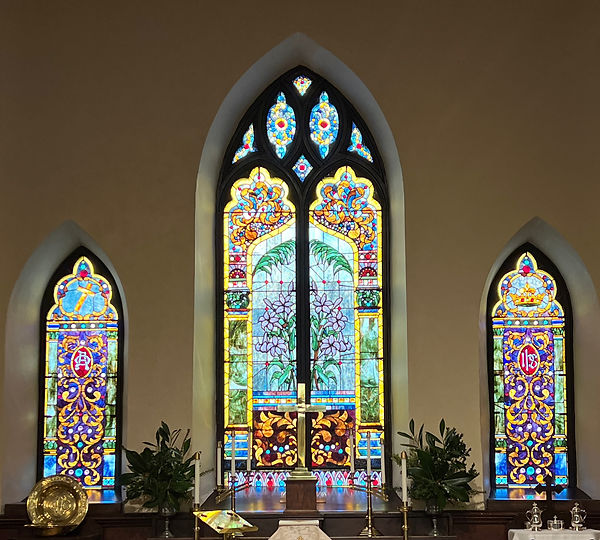
The large central window was given in memory of Henry Sigourney, a Boston manufacturer, and his wife Amelie Louise, and their three children, Alfred Germaine, William Cabell Rives and Amelie Louise, all of whom were lost at sea November 22, 1873, with the sinking of their ship, Ville du Havre, (Henry Sigourney, Jr., a fourth child, had remained at home.) Amelie Louise Sigourney was the daughter of William Cabell Rives (1793-1868, Minister to France and member of the U.S. Congress, and her godmother, after whom she was named, was the Queen of France. The window features a large spray of white lilies, a flower full of religious meaning. Blooming at Eastertide, the lily symbolizes resurrection and new life. The palm branches surmounting the lilies both recall Jesus’ triumphal entry into Jerusalem and connote victory, especially over sin and death. The window bears the Latin inscription De Profundis (“Out of the Depths”). The two smaller flanking windows correspond closely to each other in design and coloration, and they share with the central window green alabaster columns and numerous glass “jewels”. The window to the left of the central window memorializes Dr. Mann Page (1791-1850) and his wife, Jane Frances Walker (1799-1873) of Keswick Farm (now known as Old Keswick). She was a granddaughter of Dr. Thomas Walker of Castle Hill. Dr. Page was born at The Fork in Cumberland County and practiced medicine in Richmond before coming to this area. Atop this window is a gold Latin cross, the most familiar Christian symbol, while the lower panel features the interlaced Greek letters Alpha and Omega, the first and last letters of the Greek alphabet, signifying God as in the beginning and the end, the source and the goal, of all things. The window to the right of the central window was given in honor of Rev. Ebenezer Boyden (1803-1891) who served as rector of this church for forty-one years (1839-1880), longer than any other. Born in Guilford, Vermont, Boyden was a graduate of Yale (1825) and Virginia Theological Seminary (1828). He laid the cornerstone for the present building in 1849, and preached the first sermon here in 1854. At the top of the window is a crown, a symbol of victory, representing the crown of life, the reward of the faithful, as well as the “royal diadem” of the King of Kings. The lower panel features the nomen sacrum (“sacred name”) comprised of the Greek letters iota, eta, sigma, which abbreviate the name Jesus.
Nave Windows

The first window on the left side was given in memory of William Cabell Rives, Jr. (1825-1889), who was born at Castle Hill and later lived at Cobham Park. He was the son of William Cabell Rives (179301868) and Judith Page Walker Rives (1802-1882), and his wife was Grace Winthrop Sears (1828-1919), after whom this church was named. The Rives window presents two panels of lilies. Above the lilies and atop elaborate tracery, golden circles contain a chalice on the left and an open Bible on the right. These represent the two-fold and equal emphasis of the Episcopal Church on the Sacrament of the Eucharist and on the proclamation of the Word of God.
The first window on the right side of the nave was given by his family in memory of Thomas Hardy Todd (1890-1953), who lived at Eldon Farm after retiring from the practice of law in Washington. This window of blue and gold hues has as its subject the birth and childhood of Jesus. At the top are two small panels, the one on the left having the star of David, representing Jesus’ royal lineage from Dovid, and the one on the right having a lamp, representing enlightenment and knowledge, standing upon a Bible, the source of enlightenment. In the corresponding lower panels on the left we find the Nativity scene of the holy family with the stable in the background, and on the right the young boy, Jesus, teaching in the Temple. Notice that one of the teachers is wearing a yarmulke and holding the scriptures.


The second window on the left side stands in memory of George Godwise Dickinson (1832-1892) and his wife Kate Baldwin Dickinson (1827-1915). George Dickinson was a Captain of Engineers in the Confederate Army and a land surveyor in the Keswick area. He lived at Rougemont, where the stone for Grace Church was quarried. His son, Charles Edward Dickinson, was a beloved country doctor in the Keswick area. Blues, gold and pastels are featured in this widow. At the top, to the left, a chalice and a wafer represent the sacrament of the Eucharist (the wafer bears the abbreviated name of Jesus). To the right a crown encircled cross symbolizes victory and kingship. Corresponding to these symbols, the oval panels below show, on the left, Jesus administering the Last Supper with his hand raised in blessing (note the bowl of grapes on the table), and on the right, the risen Jesus ascending to heaven. This window features the quatrefoil, the ornamental design that resembles a four-petaled flower, and the fleur-de-lis. The quatrefoil evokes the biblical symbolism of four, especially the four Evangelists, while the lily is the symbol of resurrection and life.
The second window on the right side was given in memory of Joyce Fisher Butz Kram (1911-1966) by her son. The Krams were owners of Rougemont. This window, predominantly green and blue, is notable for its many animals. At the top, six doves, symbols of the Holy Spirit, are depicted between the stylized Greek letters Alpha and Omega, each surmounted by a crown. The two panels below we see on the left a horse, a lion, a rabbit, a turtle and a bird nest, and on the right two deer, a dog, a squirrel and a boy holding a red bird. Note also the lush vegetation. The representation, as the quotation shows, is inspired by Psalm 50.


The third window from the front on the left side is dedicated to the memory of Laurence Boocock by his wife, Lila Blandy Boocock. Laurence Boocock was from New York City, and his family moved to Keswick in 1895. They were the first northern family to live in this area, and resided at Castalia. At the top of this mainly blue and red window is a shield of red, symbolizing righteousness, with a flower at the center and olive branches below. The large lower panels show Jesus gesturing to the fishermen Peter and Andrew, at the Sea of Galilee, calling them to be his disciples (Matthew 4:19-20). Each of the heads is surrounded with a nimbus or halo, an ancient emblem of divine inspiration and power, but note also the red yarmulke on ;the head of one of the brothers, an indication of his Jewishness. The eight-pointed star on the bow of the boat is a symbol of baptism or regeneration, for which reason the baptismal font is octagonal in shape.
The third window on the right side is a memorial to Hunt Chipley (186901937) and his wife Sally Walker Chipley (1869-1952), natives of Norfolk who owned and spent summers at Clifton. The window, of mainly blue aspect, depicts the baptism of Jesus by John. At the top the side panels depict doves radiating the Spirit downward, and the center panels show a vine and its fruit, symbolizing Jesus as “the true vine.” The large panels below show Jesus being sprinkled by John at the River Jordan. A heavenly radiance shines upon Jesus, while the banner on John’s staff reads (in Latin) “Behold the Lamb of God.”


The last window on the left was given in memory of Jane Walker Page Lewis (1851-1945). She was a descendant of Dr. Mann Page. She and her husband, Thomas Walker Page Lewis, resided at Airslie Farm, and there she ran a school for the children of the Cismont/Keswick neighborhood. Ms. Lewis taught Sunday School at Grace Church for over thirty years, and was an energetic participant in all the activities of the church. At the top of this predominantly blue window the outer panels have crowns surmounting the Greek letters chi (X) and rho (P), which together and often superimposed constitute the “Christogram”, the first two letters of the name “Christ”. The inner panels depict, on the left, a pulpit with a nimbus, symbolizing the power of the preached Word of God, and on the right, a cross standing on a circle of red, the circle symbolizing both perfection and eternity. These are superimposed upon a vine and its branches, symbolic of Christ and the church. The lower panels show Jesus teaching and represent the Sermon on the Mount (Matthew, ch. 5-7). Notice the olive branch, symbol of peace, near Jesus and the lily, symbol of resurrection, at the foot of the children.
The last window on the right side of the nave was given in memory of Cara Inge Adams (1896-1949), who lived at La Fourche after moving to Keswick from Ashland. At the top of this window on the life is the hand of blessing fronting a cross, intended as the hand of God, while to the right is the lamb, symbol of Christ as “Lamb of God” and the Christian Paschal (Passover) lamb, holding a banner of triumph and standing on a book sealed with seven seals, these images being taken from the Book of Revelation. The main body of the window offers two scenes. In the left panel Jesus is seen blessing children (Mark 10:14-15). The standing child holds lilies of the valley, a flower that symbolizes humility. In the right panel Jesus is depicted as the good shepherd (John 10:11), In each, an intense red calls attention to the figure of Jesus,


Sacristy Window
In the sacristy (to the left of the chancel, outside the nave proper) a smaller stained glass window is dedicated to the memory of John Rogers Boyd and Nora Elizabeth Johnson. This window, predominantly red and blue against a gold background, portrays Jesus at prayer on the Mount of Olives. At the top a dove represents the Holy Spirit. The three smaller diamond panels below represent the Bible, a harp signifying the church’s musical praise of God, and wheat with grapes, signifying the bread and wine of the Eucharist.